
Duration & Credit Pulse
Executive Summary
Bottom Line: The FOMC December 2025 meeting delivered a 25 basis point cut to 3.50-3.75% with an unusually hawkish tone, as an atypical three-way dissent revealed deep divisions over the policy path. Treasury yields declined 2-5 basis points across the curve following a better-than-expected November CPI print (2.7% headline versus 3.1% expected), though the 30-year remains elevated at the 87th percentile of its 5-year range. Credit spreads held near multi-year lows—HY OAS at the 1st percentile—despite central bank policy divergence as the Bank of Japan raised rates to their highest level since 1995 while the Bank of England cut for the fourth time this year.
FOMC December 2025: Rate Cut with Hawkish Guidance
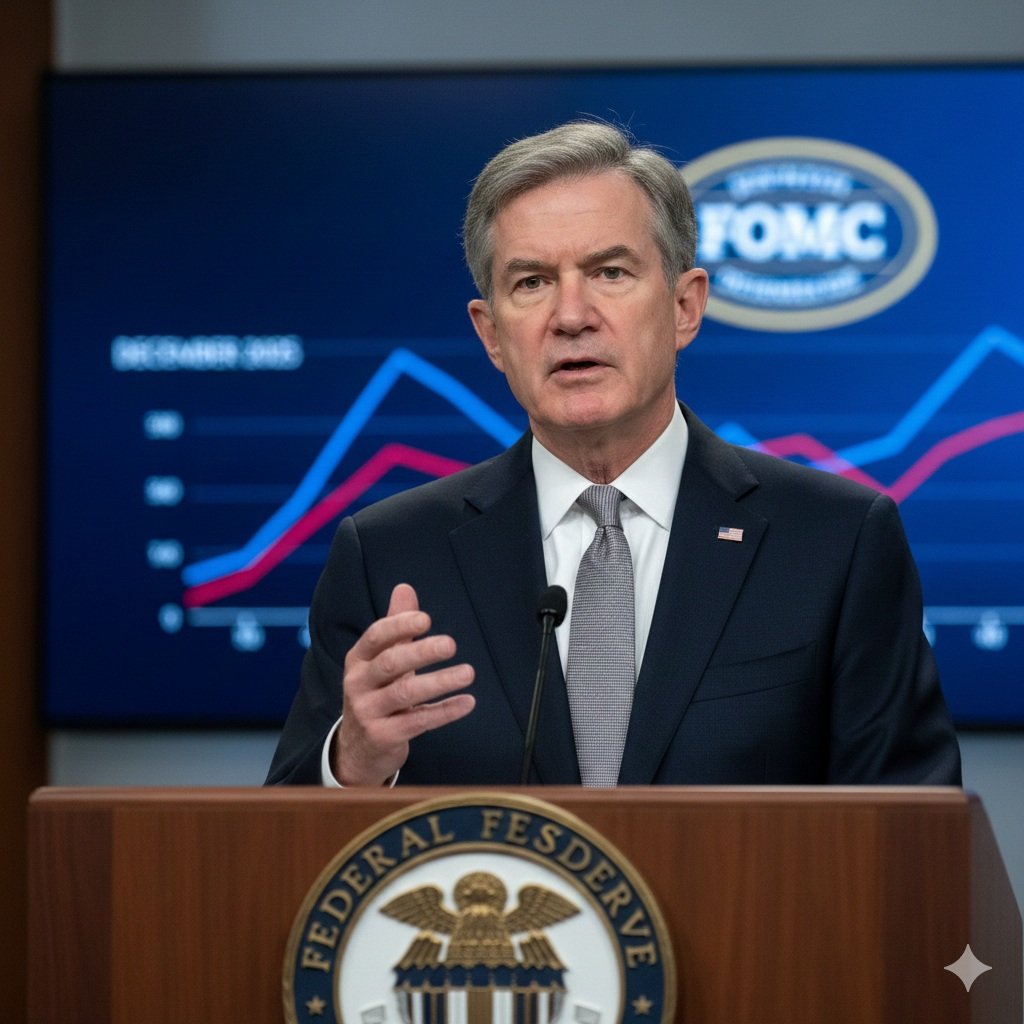
The Federal Reserve cut its benchmark rate by 25 basis points to 3.50-3.75% at the December 10 meeting, but the decision was far from unified. The 9-3 vote featured an unusual three-way dissent: Governor Miran preferred a larger 50bp cut, while Presidents Goolsbee and Schmid voted for no change. This division underscores growing uncertainty about the appropriate pace of policy adjustment.
Chair Powell's press conference reinforced a cautious outlook. The Committee inserted language about evaluating "the extent and timing" of future adjustments—identical phrasing that preceded a 9-month pause in December 2024. The updated dot plot projects just one additional cut in 2026 (median rate 3.4%), notably more hawkish than market pricing of two or more cuts.
Duration Dashboard
| Maturity | Dec 12, 2025 | Dec 19, 2025 | Weekly Δ | 5-Year Percentile |
|---|---|---|---|---|
| 2‑Year | 3.523% | 3.484% | -4 bp | 6th %ile (extremely low) |
| 5‑Year | 3.743% | 3.694% | -5 bp | 23rd %ile (low) |
| 10‑Year | 4.185% | 4.148% | -4 bp | 50th %ile (middle range) |
| 30‑Year | 4.846% | 4.825% | -2 bp | 87th %ile (elevated) |
Bull Flattening on CPI Surprise
Curve Analysis: Treasury yields declined modestly across all maturities following the November CPI surprise, with the front end outperforming slightly (2-year down 4bp versus 30-year down 2bp). The 2s10s spread held steady at approximately +66 basis points, maintaining the positive slope established after the curve's historic un-inversion. The 30-year's position at the 87th percentile of its 5-year range reflects persistent term premium demands amid fiscal concerns, while the 2-year at the 6th percentile signals expectations for continued Fed easing.
November CPI: Inflation Surprise Offers Fed Flexibility
Thursday's November CPI release provided the week's primary catalyst for rates markets. Headline inflation printed at 2.7% year-over-year against consensus expectations of 3.1%, while core CPI came in at 2.6%—representing notable progress toward the Fed's 2% target. The two-month change from September to November showed just 0.2% gains in both headline and core measures.
However, data quality concerns temper the bullish interpretation. The October government shutdown prevented BLS data collection entirely, meaning month-over-month comparisons could not be calculated. November surveying began late on November 14, potentially capturing more Black Friday promotional activity than typical. NY Fed President Williams cautioned the reading may have been depressed by approximately a tenth of a percentage point. These caveats suggest the January data will be essential for confirming the disinflationary trend.
Credit Pulse
| Metric | Dec 12, 2025 | Dec 19, 2025 | Weekly Δ | 5-Year Percentile |
|---|---|---|---|---|
| IG OAS | 74 bp | 75 bp | +1 bp | 15th %ile (low) |
| HY OAS | 252 bp | 248 bp | -4 bp | 1st %ile (extremely low) |
| VIX Index | 15.74 | 14.91 | -0.83 | 29th %ile (middle range) |
Credit markets remained anchored at historically tight levels despite elevated policy uncertainty. High yield spreads compressed 4 basis points to 248bp—sitting at just the 1st percentile of the 5-year range—while investment grade widened marginally to 75bp. The VIX declined to 14.91, approaching the lower bound of its 52-week range (14.12-60.13) and signaling constructive risk sentiment into year-end.
Global Central Bank Divergence: December 2025
Bank of Japan (Dec 18-19): The BOJ raised its policy rate 25 basis points to 0.75%—the highest borrowing cost since 1995. Governor Ueda cited on-track growth and price data supporting continued normalization. The 10-year JGB yield broke above 2% for the first time since 2011, a level that historically triggers accelerated repatriation of Japanese capital from foreign bond markets. Japanese institutional investors hold an estimated $1.1 trillion in US Treasuries and over $200 billion in European sovereigns—making this a structural risk for global fixed income.
Bank of England (Dec 17): The BOE cut Bank Rate 25 basis points to 3.75% in a close 5-4 vote, its fourth reduction of 2025. UK inflation at 3.2% remains above target but is falling faster than anticipated. Governor Bailey cast the deciding vote with the doves.
European Central Bank (Dec 18): The ECB held all rates unchanged for the fourth consecutive meeting at 2.00%, with President Lagarde emphasizing the central bank is in a "good place." Updated projections show inflation at 2.1% for 2025, falling to 1.9% by 2026. German 30-year yields touched their highest since July 2011 following the BOJ decision, demonstrating the global transmission of Japan's normalization.
US Macroeconomic Assessment – Mixed Signals Amid Data Quality Concerns
The week's economic data painted an uneven picture of the US economy, complicated by lingering effects of the October government shutdown on data collection. Manufacturing surveys delivered unexpected weakness while labor market indicators remained stable, leaving the Fed with insufficient clarity to deviate from its wait-and-see posture.
Manufacturing surveys contracted sharply: The Empire State Manufacturing Index plunged unexpectedly to -3.9 (versus +10.0 expected), a 23-point decline that broke a run of positive readings. The Philadelphia Fed Manufacturing Index printed at -10.2 (versus +2.5 expected), marking its third consecutive negative reading. However, forward-looking components offered some reassurance—Empire's future business conditions index jumped 17 points to a near one-year high, suggesting manufacturers remain cautiously optimistic about 2026 despite current weakness.
Labor market signals remained mixed: Initial jobless claims fell 13,000 to 224,000, slightly better than the 225,000 expected and reversing the prior week's increase. However, continuing claims rose 67,000 to 1.897 million—the largest weekly increase in seven months—indicating workers are taking longer to find new positions. This divergence suggests a labor market that remains tight at the margin but with growing pockets of strain.
Consumer sentiment stabilized: The University of Michigan Consumer Sentiment Index improved slightly to 52.9 versus 52.0 expected, the first increase in five months. More notably, 1-year inflation expectations fell to 4.2% from 4.5%, and 5-year expectations declined to 3.2% from 3.4%—the lowest readings since January 2025. This moderation in inflation expectations provides some comfort that the CPI surprise reflects genuine disinflationary progress rather than statistical noise.
Federal Reserve Policy Outlook
Following the December cut, the Federal Reserve appears positioned for an extended pause through at least the first quarter of 2026. The combination of a divided Committee, elevated uncertainty about tariff pass-through, and data quality concerns from the October shutdown creates a natural rationale for patience. Market pricing currently assigns roughly 58% probability to a March 2026 cut, but updated economic projections suggest the Fed sees fewer cuts ahead than markets anticipate.
Key questions for the policy path include whether November's inflation moderation proves durable once data collection normalizes, how tariff-related price pressures evolve in early 2026, and whether the labor market's underlying weakness—revealed by Powell's acknowledgment of negative adjusted job growth since April—becomes more visible in headline figures. The January 30 continuing resolution deadline also presents a fiscal policy uncertainty that could influence the Fed's calculus.
Week Ahead: Holiday-Shortened Trading
- PCE Inflation (December 20): November PCE—the Fed's preferred inflation gauge—will either confirm or challenge the CPI surprise. Core PCE expected near 2.8% year-over-year; a reading below 2.6% would reinforce the disinflationary narrative.
- Consumer Confidence (December 23): Conference Board's December reading will gauge holiday season sentiment; watch for any deterioration reflecting tariff concerns or government shutdown effects.
- New Home Sales (December 23): November data expected to show modest improvement despite mortgage rates near 7%. Housing remains a key transmission mechanism for Fed policy.
- Durable Goods Orders (December 24): November data with focus on core capital goods excluding defense and aircraft—a key proxy for business investment intentions heading into 2026.
US Economic Positioning and Global Context
The week's central bank decisions underscore a divergent global policy landscape with important implications for fixed income positioning. Japan's normalization poses the most significant structural risk for global bond markets, as higher domestic yields could accelerate repatriation of Japanese capital—estimated at $1.1 trillion in US Treasuries and over $200 billion in European sovereigns. German 30-year yields touched their highest level since July 2011 in the wake of the BOJ announcement, demonstrating the global transmission of Japan's policy shift.
For US Treasuries specifically, the combination of still-elevated long-end yields (30-year at 87th percentile) and extremely low front-end yields (2-year at 6th percentile) creates a steep curve that compensates for duration risk. The DXY dollar index held near 98.5, down approximately 8% year-to-date, though USD/JPY fell to 156-157 following the BOJ hike. Credit markets' complacency at the 1st percentile for high yield suggests positioning may be vulnerable to any deterioration in risk sentiment early in 2026.
Key Articles of the Week
-
Fed Cuts Rates for Third Time This Year Amid Economic UncertaintyCNBCDecember 10, 2025Read Article
-
Consumer Price Index Summary – November 2025 ResultsU.S. Bureau of Labor StatisticsDecember 18, 2025Read Article
-
10-Year Treasury Yield Slides After Lighter November Inflation Than ExpectedCNBCDecember 18, 2025Read Article
-
BOJ Takes Rates to 30-Year High; 10-Year JGB Breaks 2%The Japan TimesDecember 19, 2025Read Article
-
Bank of England Cuts Interest Rates to 3.75%CNBCDecember 18, 2025Read Article
-
Philadelphia Fed Manufacturing Index: Third Straight Negative ReadingFederal Reserve Bank of PhiladelphiaDecember 18, 2025Read Article
-
ECB Monetary Policy Statement and Press ConferenceEuropean Central BankDecember 18, 2025Read Article
-
Initial Unemployment Claims Down 13K, as ExpectedU.S. Department of LaborDecember 18, 2025Read Article
Frequently Asked Questions
What did the Federal Reserve decide at the December 2025 FOMC meeting?
The Fed cut rates 25 basis points to 3.50-3.75% in a divided 9-3 vote on December 10, 2025. The decision featured an unusual three-way dissent, with one member preferring a larger cut and two preferring no change. The updated dot plot projects just one additional cut in 2026, signaling a more hawkish stance than markets anticipated.
Why did Treasury yields fall after the November CPI report?
November CPI surprised lower at 2.7% headline versus 3.1% expected, with core inflation at 2.6%. This better-than-expected reading increased expectations for continued Fed rate cuts and drove Treasury yields down 2-5 basis points across the curve. However, data quality concerns from the October shutdown mean investors are awaiting January data for confirmation.
How did central bank policy divergence affect global markets this week?
The Bank of Japan raised rates to their highest since 1995, the Bank of England cut for the fourth time in 2025, and the ECB held steady. This divergence created cross-currency volatility, with Japanese 10-year yields breaking 2% and raising concerns about potential repatriation of Japanese holdings of foreign bonds.
What does high yield spreads at the 1st percentile mean for investors?
High yield OAS at 248 basis points represents the tightest valuations in the 5-year lookback period, offering minimal compensation for credit risk. While default rates remain low at approximately 1.25%, this extreme positioning leaves little cushion for any deterioration in fundamentals or risk sentiment heading into 2026.