
Duration & Credit Pulse
Executive Summary
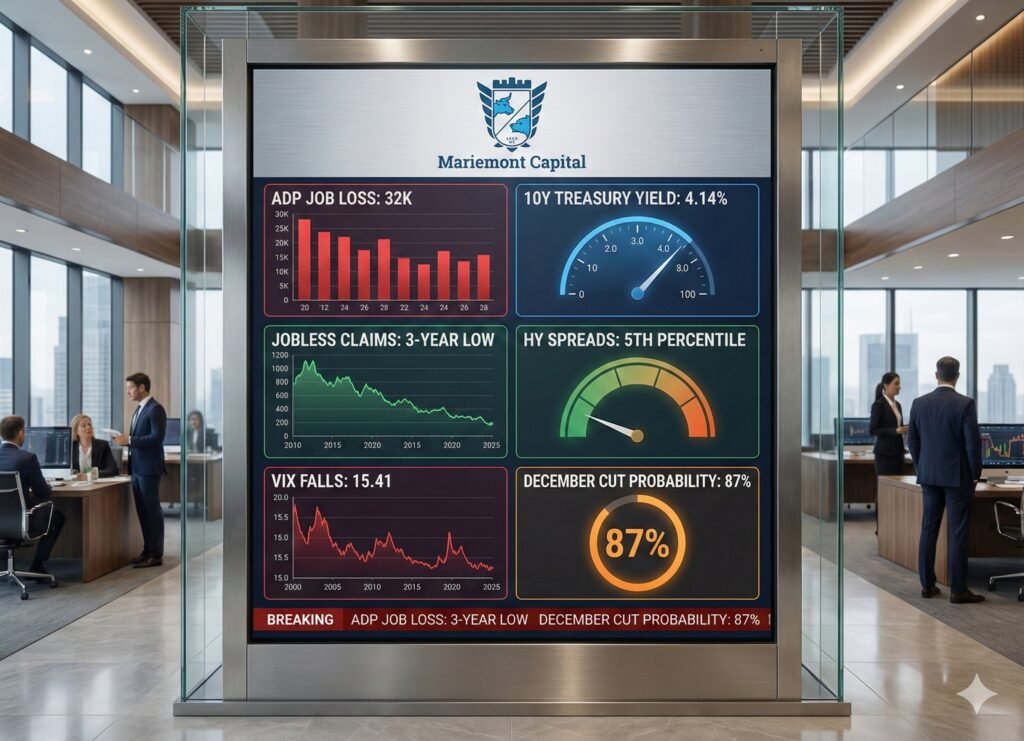
Bottom Line: Mixed labor market signals dominated the week as ADP reported a 32,000 job contraction while initial jobless claims fell to a three-year low of 191,000. This "no hire, no fire" dynamic kept markets positioned for a December Fed rate cut, with CME FedWatch showing 87% probability for a 25bp reduction. Treasury yields rose 7-13bp in a modest bear steepening pattern, with the 10-year settling at 4.14%. Credit spreads tightened to multi-year lows—high yield at the 5th percentile of its 5-year range—while volatility collapsed to levels not seen since September 2025.
Duration Dashboard: Treasury Yields Rise Ahead of December FOMC
| Maturity | Nov 28, 2025 | Dec 5, 2025 | Weekly Δ | 5-Year Percentile |
|---|---|---|---|---|
| 2‑Year | 3.49% | 3.56% | +7 bp | 38th %ile (middle range) |
| 5‑Year | 3.60% | 3.71% | +12 bp | 49th %ile (middle range) |
| 10‑Year | 4.01% | 4.14% | +12 bp | 65th %ile (middle range) |
| 30‑Year | 4.66% | 4.79% | +13 bp | 90th %ile (elevated) |
Yield Curve: Bear Steepening Ahead of December Fed Rate Cut
Curve Analysis: Treasury yields exhibited modest bear steepening, with the 2s10s spread widening 5bp to +58bp and the 2s30s spread expanding 6bp to +123bp. Long-end underperformance reflects term premium concerns despite near-certain expectations for a December Fed rate cut. The 30-year yield at the 90th percentile of its 5-year range stands out as the only metric in elevated territory, suggesting investors continue to demand compensation for duration risk amid fiscal uncertainty.
The week's yield curve dynamics reflected a market reconciling conflicting signals: weak private payroll data arguing for easier policy versus resilient jobless claims suggesting no imminent labor market deterioration. The result was a bear steepening pattern where long-end yields rose more than short-end rates, consistent with expectations that the Fed will cut in December but may slow the pace of easing into 2026. The 10-year yield's position at the 65th percentile indicates rates remain in the middle of their recent range, neither stretched nor compressed.
Credit Pulse: Spreads Tighten Ahead of December Fed Rate Cut
| Metric | Nov 28, 2025 | Dec 5, 2025 | Weekly Δ | 5-Year Percentile |
|---|---|---|---|---|
| IG OAS | 77 bp | 74 bp | -3 bp | 22nd %ile (low) |
| HY OAS | 256 bp | 244 bp | -12 bp | 5th %ile (extremely tight) |
| VIX Index | 16.35 | 15.41 | -0.94 | 24th %ile (low) |
Credit markets continued their compression trend, with high yield spreads tightening 12bp to 244bp—placing them at just the 5th percentile of their 5-year range. Investment grade spreads narrowed 3bp to 74bp, also in historically tight territory at the 22nd percentile. The VIX declined nearly a full point to 15.41, its lowest level since September 2025, reflecting what some market commentators have termed "super calm" conditions ahead of the December FOMC meeting.
US Macroeconomic Assessment – Labor Market Sends Mixed Signals
The week's economic data painted a picture of an economy in transition, with traditional employment indicators sending conflicting messages about underlying labor market health. The divergence between private payroll weakness and strong jobless claims data complicated the Fed's assessment heading into its December 9-10 meeting.
Manufacturing remains in contraction: The ISM Manufacturing PMI registered 48.2 in November, below consensus expectations of 48.6-49.0 and marking the ninth consecutive month below the 50 expansion threshold. New orders deteriorated to 47.4 from 49.4, while the employment component fell to 44.0 from 46.0. The lone positive was the production subindex returning to expansion at 51.4. This continued weakness in goods-producing sectors supports the case for monetary accommodation.
Services sector provides offset: In contrast, the ISM Services PMI came in at 52.6, slightly above the 52.0-52.1 consensus, indicating continued expansion in the larger services economy. Notably, the prices paid component declined to 65.4 from 70.0, a constructive signal for inflation. Business activity edged higher to 54.5, though employment remained in contraction at 48.9 despite improving from 48.2 the prior month.
ADP employment decline captures attention: Wednesday's ADP National Employment Report showed private payrolls contracted by 32,000 jobs in November, well below expectations for a 10,000 gain. This marked the fourth monthly decline in six months, with particular weakness in manufacturing (-18,000), professional services (-26,000), and small businesses (-120,000 net loss). Pay growth for job stayers moderated to 4.4% year-over-year. Markets initially responded with lower yields before the move partially reversed.
Jobless claims provide contrary signal: Initial unemployment claims fell to 191,000 for the week ending November 29, substantially below the 220,000 consensus and reaching the lowest level since September 2022. This suggests employers remain reluctant to reduce headcount even as hiring has slowed, consistent with a "labor hoarding" pattern that has characterized post-pandemic employment dynamics. Continuing claims edged down to 1.939 million.
Federal Reserve Policy Outlook: December Rate Cut Expectations Near Certain
Market pricing for a 25bp rate cut at the December 9-10 FOMC meeting stood at 87% by week's end, up from approximately 50% in early November. Governor Christopher Waller emerged as the most influential voice supporting continued easing, describing another cut as a matter of risk management given the labor market's mixed signals. The federal funds rate currently stands at 4.50-4.75% following cuts in September and November.
The key development for fixed income investors is the emerging consensus that the December cut may be followed by an extended pause. Bank of America's forecast of only two additional cuts through 2026 reflects growing belief that the Fed will want to assess the cumulative effect of its easing cycle before proceeding further. Chair Powell had previously cautioned that a December cut was "not a foregone conclusion," and some Committee members prefer a pause to evaluate incoming data. The updated Summary of Economic Projections and dot plot will provide critical guidance on the path forward.
Week Ahead: FOMC Decision Takes Center Stage
- FOMC Meeting (December 9-10): The week's primary event, with markets pricing 87% probability of a 25bp cut. Updated economic projections and Powell's press conference will be closely watched for guidance on the 2026 rate path.
- CPI Inflation (December 11): November consumer price data arrives day after the Fed decision. Core CPI consensus stands around 0.3% monthly, with any upside surprise potentially validating a slower easing pace into 2026.
- November Employment Report (December 16): The Bureau of Labor Statistics jobs report has been delayed from its usual first-Friday release due to the recent government shutdown. This means the Fed will make its December decision without the official November employment data.
- Retail Sales (December 13): November retail data will provide an early read on holiday shopping activity and consumer spending momentum entering year-end.
- PPI Inflation (December 12): Producer price data offers another inflation checkpoint, with pipeline pressures remaining a focus for Fed policy calibration.
US Economic Positioning and Global Context
The US economy continues to demonstrate resilience relative to global peers, though the week's labor data suggested the margin of outperformance may be narrowing. The dollar index declined below 99 to one-month lows, reflecting both rate cut expectations and broader reassessment of relative growth trajectories. Reports that the administration is considering withdrawal from the USMCA trade agreement added a layer of policy uncertainty, though tariff revenues have been running approximately $100 billion below initial projections due to high USMCA utilization rates.
Global central bank divergence: The Bank of Japan emerged as a notable hawk, with Governor Ueda indicating the BOJ is weighing the pros and cons of raising rates at its December 18-19 meeting. Bloomberg reported officials are ready to raise rates to 0.75%, which would be the highest level since 1995. This potential policy divergence from the easing Fed could influence dollar-yen dynamics and global fixed income flows. European political uncertainty also remained elevated following France's government collapse earlier in the week, though market impact was limited. The calm volatility environment—both VIX at 15.41 and the MOVE index at multi-year lows—suggests investors have grown comfortable with current positioning, a condition that historically precedes regime shifts.
Key Articles of the Week
-
ADP National Employment Report: Private Sector Employment Shed 32,000 Jobs in NovemberADP Media CenterDecember 3, 2025Read Article
-
Manufacturing PMI at 48.2%; November 2025 ISM Manufacturing ReportInstitute for Supply ManagementDecember 1, 2025Read Article
-
Services PMI at 52.6%; November 2025 ISM Services ReportInstitute for Supply ManagementDecember 3, 2025Read Article
-
U.S. Treasury Yields: Investors React to Latest Jobs DataCNBCDecember 3, 2025Read Article
-
December Fed Meeting: A Rate Cut Looks Likely, but So Do Growing DivisionsMorningstarDecember 5, 2025Read Article
-
US Weekly Jobless Claims Drop to Lowest Level in More Than Three YearsReuters via KSGFDecember 4, 2025Read Article
-
VIX and Global Volatility Indices Signal 'Super Calm' Before the FedTS2 Market AnalysisDecember 5, 2025Read Article
Frequently Asked Questions
What is the probability of a December 2025 Fed rate cut?
CME FedWatch showed an 87% probability of a 25 basis point rate cut at the December 9-10 FOMC meeting as of December 5, 2025. This probability increased from approximately 50% in early November following comments from Governor Waller supporting continued easing and mixed labor market data suggesting the Fed has room to cut.
Why did Treasury yields rise despite expectations for a Fed rate cut?
Treasury yields rose 7-13bp across the curve in a bear steepening pattern, with long-end yields rising more than short-end rates. This reflects expectations that while the Fed will cut in December, the pace of easing may slow significantly into 2026. The 30-year yield at the 90th percentile indicates investors continue to demand term premium compensation for duration risk.
How tight are credit spreads currently?
High yield spreads at 244bp represent the 5th percentile of their 5-year historical range—extremely tight by historical standards. Investment grade spreads at 74bp sit at the 22nd percentile, also historically compressed. These tight valuations leave limited cushion should economic conditions deteriorate beyond current expectations.
What did the ADP employment report show for November 2025?
ADP reported that private payrolls contracted by 32,000 jobs in November, well below expectations for a 10,000 gain. This marked the largest monthly decline since March 2023 and the fourth monthly contraction in six months. Manufacturing lost 18,000 jobs and professional services shed 26,000, while pay growth for job stayers moderated to 4.4% annually.